Death Railway
The Narrow Road to the Deep NorthThe Death Railway is a military railway planned by the Imperial Japanese Army from north of Bangkok through to Burma. Its construction joins a strategic project to a vast system of forced labor: the route is marked by surveyors’ pegs, enlarged through successive engineering demands, and built by prisoners and other coerced workers under conditions that produce widespread death. The novel also follows what becomes of the railway after the war, when its military purpose disappears and the physical line is dismantled, overgrown, and only partly preserved as a place of public memory.
Strategic purpose and planned route
The railway arises from Japan’s worsening military position in 1943. The Allies were supplying the Chinese Nationalist Army through Burma, while American control of the seas made maritime supply difficult for Japan. Japanese leaders sought a land route to supply their forces in Burma and pursued the larger ambition of taking India through Burma. They lacked the money, machinery, and time for the undertaking, but the novel presents the project as driven forward by imperial belief and the conviction that the Emperor’s will could overcome practical limits.
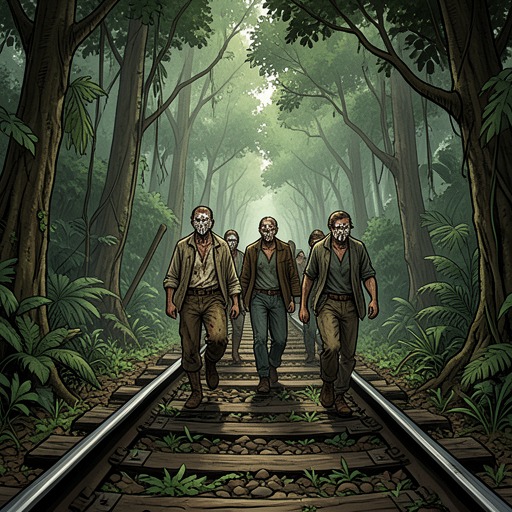
At the worksite, Dorrigo Evans sees a straight line of pegs driven into the ground by Imperial Japanese Army engineers. The route is described as extending 415 kilometres from north of Bangkok toward Burma. At this early point it remains a plan rather than a completed railway: its intended course is marked out, but the project still depends on orders, labor, and materials that have not yet been secured. Prisoners are given blunt axes and rope and assigned to clear a kilometre of giant teak trees along the projected route. In this opening task, the railway is at once an abstract engineering line and a physical demand imposed on the men required to make it real.
Engineering demands and forced labor
The railway’s technical requirements do not remain fixed. After a major cutting is already half-completed, the Railway Command Group orders it enlarged by a third to address gradient problems in the next sector. The revision adds 3,000 cubic metres of rock to be cut and removed. Yet the worksite lacks adequate equipment: prisoners break rock by hand with hammers and chisels, and the available chisels cannot be sharpened reliably because there is not enough coke for the forge. Major Nakamura identifies drilling machines and compressors as useful, but the engineering need exists within a system that continues to demand completion despite the shortage of tools and the dwindling workforce. Colonel Kota makes clear that the work is to be finished even if most of the laborers die, or if none survive.
The novel links these specifications to the treatment of people as replaceable inputs. Prisoners clear jungle, break rock, move earth, and carry sleepers and rails with hand tools and their own labor. Starvation, illness, beatings, and exhaustion reduce the available workforce even as the railway’s demands continue. The project’s practical problems—its gradients, cuttings, tools, and labor supply—therefore cannot be separated from the human cost of the decisions made to keep it advancing. The railway is not merely built under harsh conditions; its construction system makes human survival subordinate to the completion order.
The prisoners’ journey to the worksite illustrates how transportation itself becomes part of their confinement. A thousand men who leave Changi as Dorrigo Evans’s J Force are officially designated as a unit and sent north in closed rice wagons, with twenty-seven men packed into each wagon. They travel for five days without food; three men die during the journey. At Ban Pong they are transferred to trucks for the onward trip through the jungle. This unit is only one part of the larger labor force, but its experience connects the railway’s route to the men who are made to work along it.
The scale of that larger labor force is difficult to establish precisely. The novel states that about 60,000 Allied prisoners worked on the railway, alongside roughly a quarter of a million Tamil, Chinese, Javanese, Malayan, Thai, and Burmese laborers, or possibly more. Estimates for deaths among these Asian workers range from 50,000 to 200,000, and the account stresses that no agreed total exists. Of 22,000 Australian prisoners of war held by Japan, 9,000 were sent to work on the railway. When the first train runs the length of the completed line on 25 October 1943, the remains of one in three of the Australians are said to lie along it. These figures make the scale of the project visible while also exposing how many of its victims remain uncounted.
The Line in prisoners’ lives
Among the prisoners, the railway becomes known simply as the Line. The name marks a division between those who have endured the work and the rest of humanity, though the novel also questions whether survival alone can define that distinction. For Dorrigo Evans, looking back at the pegs, the line suggests a passage from reality toward something beyond ordinary comprehension: a route from life toward death, whose measurable length cannot convey what those who worked on it experienced. The railway’s physical simplicity—a path between two points—contrasts with the difficulty of communicating what took place along it.
Dorrigo Evans’s J Force retains its identity even as deaths reduce its numbers. The men are presented as a continuing collective, bound by a belief in one another and by the conviction that the living must not abandon the dead. That identity lasts beyond the railway camp: the force remains a thousand souls in the account’s communal memory even if, by the end, only one man might remain to leave. The railway thus measures both the destruction of the group and the persistence of its shared name and obligation.
Completion, memorials, and decay
On 25 October 1943, steam locomotive C 5631 travels the full length of the completed railway, towing three carriages of Japanese and Thai dignitaries. The achievement of the line is presented beside the deaths that made it possible. C 5631 is later displayed at the museum associated with Yasukuni Shrine in Tokyo, while the plaque before it does not mention the railway’s construction or the dead who lie along its route. The shrine also contains the Book of Souls, listing more than two million people who died in service to the Emperor of Japan between 1867 and 1951. Among its names are 1,068 men convicted of war crimes after the Second World War and executed; some had worked on the Death Railway and been found guilty of mistreating prisoners. The juxtaposition of the locomotive, the shrine, and the absent names of the laborers exposes how commemoration can preserve a machine while leaving the human cost unacknowledged.
After Japan’s imperial project is defeated, the railway loses its military purpose and support. Japanese engineers and guards responsible for it are imprisoned or repatriated, and the laborers who remain to maintain the line are freed. The Thais abandon it, the English dismantle it, and local tribespeople pull up and sell sections. Rain and time then weaken the remaining banks, bridges, and cuttings; vegetation grows through the abandoned works. Decades later, a few short sections are cleared and turned into tourist, sacred, and national sites, but these fragments do not restore the railway as a functioning system.
The final history of the Death Railway is therefore not a return to its original condition but a sequence of removal, decay, and partial memorialization. Its builders’ imperial design proves temporary; the line is broken, and the jungle spreads across what remains. The novel sets that physical impermanence against the unresolved record of human loss: the railway’s course can be dismantled and reclaimed, while the names and numbers of many who died constructing it remain unknown.